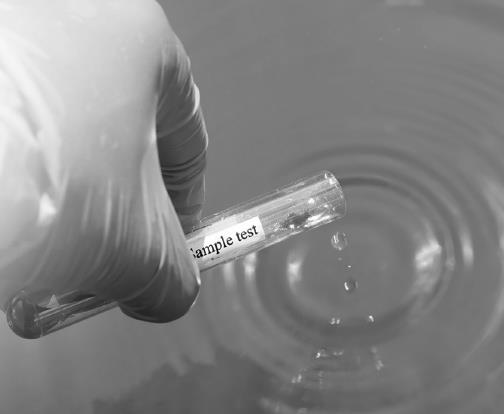


Well owners can screen their well water for common contaminants November 18 and 19 at Hays County AgriLife Extension Office at 200 Stillwater Road, Suite 102.
The event is part of the “Well Informed” Texas Well Owner Network, or TWON, an educational program that gives owners the opportunity to have samples from their well water screened for contaminants such as fecal coliform, E. coli bacteria, nitrates and high salinity.
The screening is followed by a one-hour explanation of the results, water well protection practices, well-head protection and recommendations for remediating well contamination.
The explanation will be held Thursday, November 19 at 9 a.m. at a Results and Interpretation meeting in the Blanco County Community Resource Center, 206 Highway 281 South in Johnson City.
Each sample should have an information form attached.
The information form can be downloaded at twon.tamu.edu. Instructions on how to collect a sample can also be downloaded at twon.tamu.edu.
Samples should be collected in a new, unused 12 to 20 ounce water bottle and dropped off from 8:30 to 11 a.m. The cost for screening is $15.00 and multiple samples are accepted. The instructions are also below.
Other locations where samples can be dropped off on November 18 are the Blanco County AgriLife Extension Office, 200 N. Ave. G, Suite 7, and the Blanco-Pedernales GCD Office, 601 W. Main Street, both in Johnson City.
WATER SAMPLE INSTRUCTIONS
For water samples: Please complete the water sample form for each sample you submit and follow the directions below for the sample collection.
Step 1: Please use a new bottle of water (12 to 20 ounces), pour out the contents and fill with a water sample from your private water well. Take the sample from the spigot/hose bib nearest to the well head.
Remove the water hose if there is one and take directly from the spigot/hose bib.
If an inside faucet is used, you will need to remove the aerator on the faucet before making the collection.
Rinse and dry the exterior of the faucet to prevent exterior contamination of your water sample. If possible, wipe off with a Clorox-type towelette or paper towel wetted with a light bleach solution to kill any bacteria present on the faucet.
Allow the solution to dry before sampling. Turn on the water full force and let it run at full force for two minutes or until you hear the pump start running.
Reduce the water flow to a small stream.
Step 2: Refrigerate the sample and transport it to the Extension office or the GCD office (in an ice chest) as soon after collection as possible. It is best to collect the day of the workshop if that is possible otherwise make sure the sample is kept cool and out of direct sunlight.
Sample should be collected within 24 hours before the workshop to ensure accurate results.
Step 3: We encourage you to bring samples from all wells on your property; many participants that have water treatment equipment take samples before and after treatment to make sure the equipment is functioning properly.
Also we need for you to label the sample with your name (if you bring more than one sample you also need to label the sample in some way to make sure you know which well the sample comes from). We will be screening for Nitrates, TDS (salinity) and bacteria (absence or presence of coliform and E. coli) with your sample.